
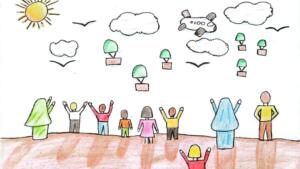
©Drawing created by a child accompanied by Doctors of the World
The numbers are almost too large to hold: 20,179 children killed, 44,143 injured, more than 58,500 who have lost one or both parents, and 21,000 living with disabilities they didn’t have before the war began. Gaza now has the highest concentration of child amputees in the world.
These are not abstractions. They are the documented findings of the United Nations Independent International Commission of Inquiry, published in June 2026—a systematic accounting of what the conflict has done to an entire generation of children.
And the Commission notes that even these figures are probably an undercount. Some deaths could not be documented.
A childhood taken apart
The numbers tell part of the story. The rest is harder to quantify. Schools have been destroyed, health facilities gutted, safe spaces erased. Children have been displaced not once but repeatedly—watching family members die, losing any stable ground to return to, physically or psychologically.
By 2024, according to UNICEF, almost every single child in Gaza was already in need of mental health and psychosocial support. That was before another year of conflict…another year of loss. The UN Commission describes what is happening to Palestinian children not as collateral damage but as a structural threat to the development and survival of an entire generation.
Children in the West Bank have faced detention, including a record number held in administrative detention, while children across Gaza are living with trauma that will shape them long after any ceasefire. The wounds that don’t show up in the statistics are the ones that will last the longest.
Giving children back to themselves
In conditions that make humanitarian work extraordinarily difficult, Doctors of the World teams are present in Gaza, working with children and their families to address what the conflict has left behind. That work includes individual and group psychological support, psychological first aid in crisis situations, and therapeutic and recreational activities designed to give children something the conflict has taken away: a moment of safety, of play, of being seen as a child rather than a casualty.
Our teams are also supporting children and adolescents who have experienced detention, violence, and displacement—and strengthening the capacity of healthcare workers, teachers, and community members to recognize and respond to psychological distress in the people around them.
This is slow, painstaking work, happening in the margins of an active conflict under access constraints that change daily. It is not enough. But it is what is possible, and Doctors of the World will not stop doing it.