
©Alex Zapico/Médicos del Mundo
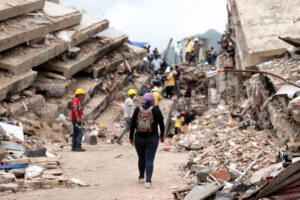
The sirens have gone quiet. Search-and-rescue teams are standing down. And for much of the world, the Venezuela earthquake story is fading from the headlines.
But for the people still sleeping in parks, vehicles, and makeshift shelters across Caracas and La Guaira—after two massive earthquakes tore through their communities—the emergency is far from over. It has simply changed shape.
“Surviving does not mean having overcome the earthquake,” says Ricardo Angora, a psychiatrist deployed with Doctors of the World in Venezuela. What he and his colleagues are seeing on the ground tells a more complicated story than any headline: the visible wounds are healing. The invisible ones are just beginning to surface.
When the adrenaline wears off
©Alex Zapico/Médicos del Mundo
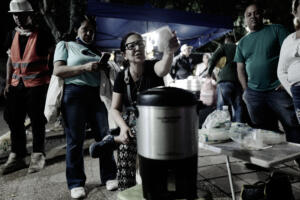
In the immediate aftermath of a disaster, people operate on urgency. There is no time to grieve, no space to feel afraid. There is only the next task—finding water, locating a family member, securing shelter.
But as the weeks pass and the immediate danger recedes, something shifts. Exhaustion sets in. And with it comes everything that was held at bay: the fear, the loss, the grief that has nowhere to go.
Marina Stussi, Doctors of the World’s mental health coordinator for the Venezuela earthquake response, describes the pattern playing out across affected communities: “During the first days, people focus on surviving and solving immediate problems. But as time passes, exhaustion sets in, and they begin to connect with pain, loss, and despair.”
That connection is becoming unavoidable.
Rescuers also need to be rescued
©Alex Zapico/Médicos del Mundo
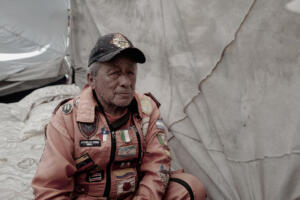
The emotional toll isn’t carried only by those who lost homes or loved ones. The rescue workers who spent weeks pulling people from the rubble are beginning to show the weight of what they witnessed.
“I’m starting to notice a growing need for emotional therapy because of post-traumatic stress,” one rescuer shared. “Emotional fatigue is becoming more noticeable.”
Another described the particular burden of feeling unable to stop: “We know we still have to hold on a bit longer. We can’t break down because there’s still so much to do.”
This is the paradox Stussi knows well. For professionals responding to disaster, there is an added psychological barrier: the belief that they must remain strong in order to keep helping others. Precisely because of that belief, they are among the groups at highest risk of developing post-traumatic stress disorder.
Grief that still has no end
©Alex Zapico/Médicos del Mundo
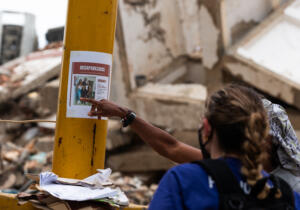
Unlike other emergencies, grief after an earthquake often has no clear endpoint. Weeks after the disaster, many families are still waiting for news of missing loved ones—or for the recovery of bodies so they can begin the process of saying goodbye.
There is a persistent myth in disaster recovery that time alone heals trauma. That it’s enough to say “at least you’re alive.” What truly helps is recognizing emotions, validating them, and accompanying people through what they have lived—not asking them to move on before they are ready.
Children, carrying what they cannot name
©Alex Zapico/Médicos del Mundo
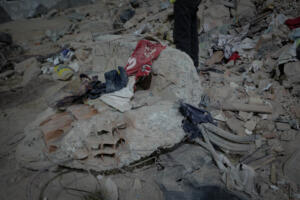
Of all the groups Doctors of the World’s teams are monitoring, children are among those causing the most concern.
“Many children are experiencing severe psychological trauma,” Angora says. “Many are afraid to return home, even when their houses are still safe to live in.”
Sleep disturbances, separation anxiety, fear of being alone, sudden behavioral changes: these are the signs that disaster has settled into a child’s nervous system in ways that are hard to reach. For families already navigating the loss of homes, income, and stability, a child’s psychological distress adds another layer to an already impossible situation.
The weight of a life rebuilt and lost
©Alex Zapico/Médicos del Mundo
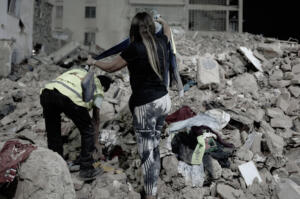
Psychological consultations reveal stories that go far beyond property damage.
Angora describes one patient who stays with him: a recently retired man who had spent 35 years saving for a home. The earthquake destroyed it. “He survived,” Angora says, “but feels he has lost the possibility of starting over. He sees no way out.”
His story is not unusual. Among older adults, among families who lost everything they had built, among people now facing a future defined by uncertainty—survival and recovery are not the same thing.
The reconstruction that doesn’t make the news
©Alex Zapico/Médicos del Mundo
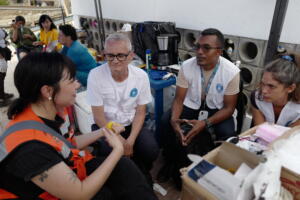
One month after the Venezuela earthquakes, Doctors of the World is reinforcing primary healthcare, psychosocial support, and psychological care across affected communities—with particular attention to displaced people, children, older adults, and the rescue workers who have been holding everyone else together.
Mental health is almost always the last thing funded and the first thing forgotten when the cameras leave.
As the world’s attention moves on, the hardest reconstruction is only just beginning—not of buildings, but of the inner lives of people who survived something that will take far longer than a month to process. Doctors of the World will be there for that work, as it has been in Venezuela since 2019, long before the earthquakes, and long after the emergency has a different name.
Please donate to our Emergency Response Fund for Venezuela to provide lifesaving care and essential support for the people most impacted by this disaster.