
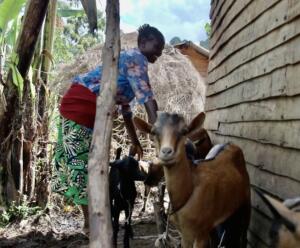
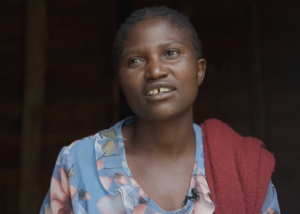
“I usually cook in the room where my goats sleep,” says Pascasie Nzigiri, a farmer and livestock breeder in South Kivu, in eastern Democratic Republic of Congo. “I use the same pots for cooking and for feeding them, which means there is a risk.”
Pascasie lives at the edge of Kahuzi-Biega National Park—a UNESCO World Heritage Site and one of the most biodiverse places on earth, part of the Congo Basin rainforest. Home to the last remaining eastern lowland gorillas and over 350 bird species, it is a place of extraordinary natural richness. It is also a place where the boundary between human and wildlife habitat has worn dangerously thin.
A 2023 community survey found that 60 to 80% of households here have daily contact with animals, often sharing the same roof due to a simple lack of space. To Dr. Luis Florès, a veterinarian and researcher at the Natural Sciences Research Centre in Lwiro, these are exactly the conditions that make this region nothing short of a “hotspot for the emergence of pandemics.” The region sits close enough to a major international airport that, in his words, “a virus can quickly spread all around the world.” It is no coincidence, he notes, that Ebola first emerged in North Kivu, the neighboring province.
What Dr. Florès described is now unfolding. With more than 2,000 confirmed cases and over 700 deaths, the current Ebola outbreak has spread beyond DRC’s borders—crossing into Uganda.
Most human infectious diseases originate in animals, and the majority of those trace back to wildlife. As deforestation pushes people and wild animals into closer contact, that risk only grows.
A predictable emergency
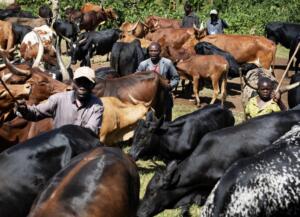
Photo by Thomas Cytrynowizc
The current Ebola outbreak didn’t emerge out of nowhere. It emerged from conditions researchers have long identified as the defining risk factors for zoonotic spillover in the Congo Basin: deforestation, mining, logging, and forest conversion pushing wildlife into closer contact with communities; hunting practices that bring people into direct contact with potentially infected animals; and weak surveillance systems unable to detect disease crossing from animals to humans early enough to stop it.
These conditions are not unique to this region, but they are acutely present here. They are part of the daily reality Pascasie navigates—the goats in the kitchen, the shared cooking pots, the proximity to animals that public health experts consider a warning sign.
The outbreak was detected only after more than 240 suspected cases and dozens of deaths had already been recorded. It is made more dangerous still by the fact that this particular strain—the Bundibugyo virus—has no approved vaccine and no specific treatment. Early detection isn’t just the most cost-effective response. It is the only one available.
As concerns over disease outbreaks grow, the surveillance programs designed to catch them are being weakened. Animal health receives less than 0.6% of global health spending, yet 60% of human infectious diseases originate in animals. And U.S. support for global health security programs at USAID and CDC faces a proposed $500 million cut in the coming year, on top of a broader freeze that disrupted programs last year
A different way of seeing health
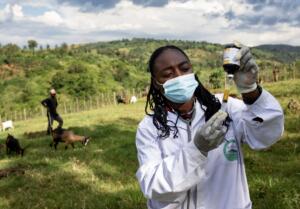
Photo by Thomas Cytrynowizc
For the past several years, Doctors of the World has been running a dedicated One Health program in communities near Kahuzi-Biega National Park in eastern DRC, working alongside Veterinarians Without Borders Belgium and local partner Action for Rural Development (ADMR). More recently, the program has expanded to northern Niger, where agropastoral and nomadic communities face similar risks: recurring disease outbreaks, low vaccination coverage, and limited access to health services.
In both contexts, the program—which is part of a growing global movement—is built on a simple but powerful idea: that human health, animal health, and environmental health cannot be treated in isolation.
“The role of Doctors of the World involves training healthcare providers, specifically doctors and nurses, in community-based surveillance, as well as the diagnosis and management of zoonotic diseases,” explains Jean-Pierre Mandevu, a Doctors of the World staff member working on the project.
For families like Pascasie’s, the risks of living alongside animals are not abstract; they are woven into the fabric of daily life. But within that reality, knowledge can still open new possibilities.
“We learned that there is a link between animals, humans, and the environment,” Pascasie says. That realization—and the practical alternatives the program made possible—is already changing daily life for families like hers. “In the past, when a goat died, we would eat it,” she says. “But since we’ve been made aware, we now know it has to be buried.”
The approach also works upstream of disease itself. Doctors of the World teams have produced and distributed more than 190,000 plants across 400 hectares and trained residents to build low-emission cookstoves—small interventions aimed at reducing the deforestation that drives people and wildlife into riskier contact in the first place.
Across both programs in 2025, 91,475 people were reached with awareness campaigns, 461 people were trained in One Health approaches, disease alert reporting increased by 75%, and 8 One Health committees are now operational. In DRC specifically, 90% of trained health agents have strengthened their capacity for integrated disease surveillance, and a first-of-its-kind observatory now monitors zoonotic disease and antimicrobial resistance in the region.
“Today, health workers are better able to identify and treat these diseases,” says Dr. Gali Ngengele, our One Health Community Supervisor in the DRC, “thereby improving the response to infections that affect both humans and animals.”
Treating the whole picture
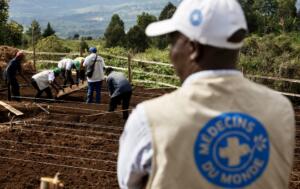
Photo by Thomas Cytrynowizc
Doctors of the World formally adopted the One Health approach as a strategic priority in 2021. In communities like Pascasie’s, living alongside animals isn’t a matter of choice; it’s a matter of necessity. Families share space with their animals not because they don’t understand what’s at stake, but because they have no other option.
That’s why the most effective response isn’t just awareness. It’s working alongside communities to create real alternatives: a seedling instead of a tree cut from the forest, a low-emission stove instead of more charcoal, a burial instead of a meal that carries risk.
A real shift in how we think about human health—not as something separate from animal and environmental health, but as something fundamentally tied to it—is what makes sustainable prevention possible. Doctors of the World is on the ground in eastern DRC and Niger, working alongside communities to build the kind of health systems that address these challenges at their roots.