
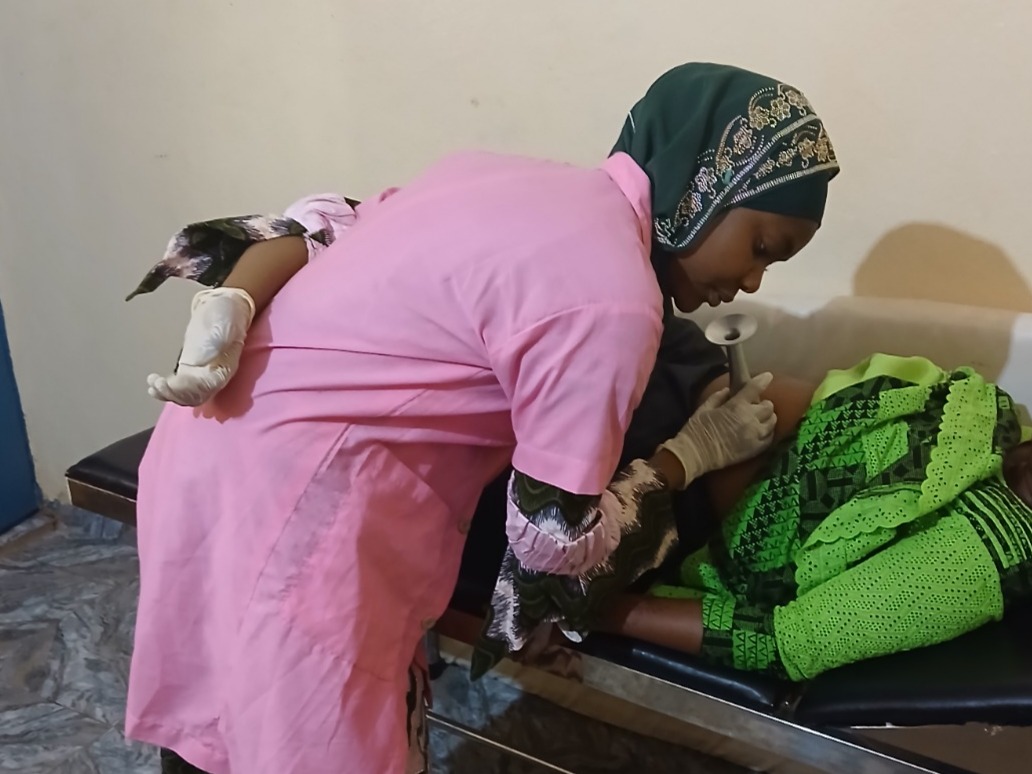
Most days, you can find 27-year-old Marie at a small clinic in Konni, a district town in the Tahoua region of Niger, some 400 kilometers east of the capital. She might be conducting an emergency ultrasound, sitting with a survivor during a difficult consultation, or coordinating with the psychosocial team about a patient who just came in.
In December 2023, Marie joined Doctors of the World’s one-stop center in Konni—a facility that provides free, holistic care to survivors of gender-based violence. It is, in many ways, the work she’d been preparing for her entire life.
“I always wanted to take care of children, pregnant women, and victims of gender-based violence,” she says.
After completing her bachelor’s degree, Marie earned an advanced degree in obstetric sciences at the National School of Public Health of Niger. She chose midwifery because she longed to help people during their most difficult moments—and, in Konni, there is no shortage of them.
Climate shocks, political instability, and security restrictions—including mandatory military escorts required to reach many communities—have made humanitarian access increasingly difficult in Niger. And in this environment, women and girls face heightened risks of sexual and gender-based violence, while access to care and support remains limited.
An integrative approach
Marie’s role at the center is all-encompassing. She performs gynecological and obstetric exams on survivors of physical and sexual violence, conducts pregnancy tests and emergency ultrasounds, and makes sure each patient is connected to legal and psychosocial services. The consultations, she says, are often hard to get through.
“Through these consultations,” she says, “I feel like I’m helping them repair, in part, the harm caused by the violence they have suffered.”
In 2024, Doctors of the World’s team in Niger provided more than 142,000 medical, psychosocial, and community consultations across the country. The following year, the one-stop center in Konni alone helped 97 survivors of gender-based violence.
Behind every one of those numbers is a story. And, one in particular, has stayed with her.
A life saved, a loss survived
Marie recalls how a 13-year-old girl arrived at the center two weeks after giving birth. She had been raped, forced to carry the resulting pregnancy with zero prenatal care, and then had to endure a grueling, complicated delivery.
When she came in, she was experiencing frequent fainting spells—something Marie recognized immediately as a grave cause for concern. Her team found that she was suffering from an infected perineal tear.
“This infection could have cost her her life if it had not been discovered in time,” Marie says.
The girl was hospitalized, given antibiotics and pain medication, and later underwent reconstructive surgery. But, tragically, her baby did not survive.
She was provided with psychosocial support to help her begin to process the immense trauma that she had endured.
“This story affected me deeply,” Marie says. “Yet I am more determined than ever to use my skills as a midwife to act for the protection and empowerment of women and girls in my country.”
Breaking the silence
Beyond providing intricate medical care, one of Marie’s biggest challenges is something an exam could never solve: convincing survivors—and, when they are minors, their families—to pursue legal action.
The pressure not to is enormous. Perpetrators are often husbands, neighbors, or family members. And reporting usually means naming someone the community knows. “Impunity is one of the causes that allows gender-based violence to persist,” Marie says.
It’s part of why the one-stop center was designed the way it was—so that the same clinic where a woman receives medical care can also connect her to legal support, counseling, and pathways toward economic independence. One place. Free of charge. Open to anyone who needs it.
But these types of programs are increasingly under threat.
When funding vanishes
Recent humanitarian aid cuts to the gender-based violence programs have already caused over 3 million women and girls to lose access to these critical—and, oftentimes, lifesaving—services. This has left entire communities without essential protection and support.
Programs like this one-stop center, which provides comprehensive care in a single space, are particularly vulnerable. When funding disappears, these centers struggle to keep their doors open. And the entire integrated system—the medical care, the legal aid, the psychosocial support—can collapse.
The 13-year-old Marie treated survived because a trained midwife with the right resources was there when she needed her most. That’s what’s at stake when programs like this one are threatened.
In the face of it all, Marie’s answer to the violence and uncertainty is the same as it has always been: show up every day, for every patient who walks through the door.